


Reverse Osmosis System 190L/day, 1-stage - Aquili
€78,20
Taxes included.
Shipping calculated at checkout.
Details
Aquili Reverse Osmosis RO Basic system 190L/day with 1 filter
Reverse osmosis is a technology that uses the ability of semi-permeable membranes to separate water from the substances dissolved in it. By applying a certain pressure (from the water mains), water is forced through the membrane, so that the pure water (permeate) is separated from the water containing salts (concentrate). The membranes have been tested at 25°C, 4.8 bar, and 2000 ppm TDS. Due to operating conditions differing from the ideal ones in which they were tested, actual production is about half of the theoretical yield. The Aquili RO Basic Reverse Osmosis 190L/day 1-filter system consists of: - In-line Activated Carbon 2” filter treated with specific acids for water purification; - Osmotic membrane with a flow rate of 50 gallons per day (1 gallon = 3.785 liters).Assembly and use
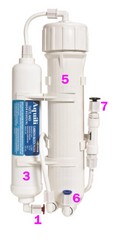
- Water inlet from the mains (red cap)
- Sediment pre-filter
- Activated Carbon filter
- Membrane flushing valve
- Osmotic membrane
- Permeate – Osmotic water (blue cap)
- Concentrate – Waste water with Flow Restrictor (black cap)
- Anti NO3-PO4-SiO2 filter
- Remove the colored caps.
- In the system, water enters from the mains tap via the connection (fitting found inside the bag), reaches a universal fitting (1), and passes through a sediment pre-filter (2) that retains particles larger than 0.005 mm (5 microns). (The RO Basic model does not have a sediment filter; in this case, the carbon filter also acts as a 5-micron mechanical filter). After this first purification, the water is passed through an activated carbon cartridge (3) which removes chlorine and also eliminates traces of pesticides, herbicides, metals, and any unpleasant taste and/or odor that the water may release.
- After passing through the carbon filter, the water is sent, under pressure, to a special membrane (5) that allows only pure water to pass through. Substances that harden the water and harmful ones such as salts, carbonates, sulfates, heavy metals, pesticides, and even bacteria and viruses are retained and rinsed away with the residual water. For assembly, the membrane must be inserted into its housing, ensuring that the thicker O-ring remains towards the cap, while the two small O-rings remain at the bottom. The quality of the osmotic membrane is decisive for achieving the desired effect; the membranes used in Aquili appliances (polyamide/polysulfone) are extremely resistant to bacterial attack, have a long service life, are easy to store, and remain unaltered for years. Once treated, the water is pre-channeled into the central tube of the membrane and exits, extremely pure, through the central conduit (6).
- For the first start-up of the system, turn on the water tap and rinse the appliance for at least two hours to completely eliminate the membrane's dry preservative; during this period, check that at least four times as much concentrate flows through the canalization (7) compared to the osmotic water produced.
- It is recommended to use the system for half an hour at least once a week; if the system remains unused for more than 14 days, drain the osmotic water for at least 5 minutes before the next use. If the system is not used for long periods, prevent the membrane from drying out by replacing the 3 colored caps.
Warnings
- Connect the system always and only to a cold water pipe (maximum 30°C), otherwise the retention rate will deteriorate and the membrane may be damaged prematurely.
- Check that the membrane is pushed all the way to the bottom before screwing on the container lid (4). (The central tube of the membrane must be aligned with the edge of the container without the lid).
- Do not force the fittings (especially the elbow fitting – Flow Restrictor), but if the system shows leaks once started, use Teflon tape.
- Run water through the carbon filter before connecting it to the membrane so that any impurities present can be purged.
- Osmotic water and residual water must always be able to flow out freely; never close them with taps or similar devices.
- Protect the membrane from frost and drying out. Once used, the membrane must not be allowed to dry.
- The pH value of the permeate is not predictable; high pH values can be easily corrected downwards with O2; if the pH value is too low, it is sufficient to aerate the obtained water thoroughly.
- It is not possible with reverse osmosis to eliminate particularly high single values, for example a high content of silicic anhydride or nitrate.
- Do not leave the machine unattended during use.
- Do not use the water for human consumption.
- Always use original spare parts.
- Regularly change the sediment pre-filter and the carbon filter. The function of the activated carbon is to retain chlorine which, if passed through, irreparably damages the membrane by tearing its microstructure. Salts will not be retained optimally and the microsiemens value of the output water will increase.